Turn failed payments into recovered revenue.

AI that detects payment failures, understands why they happened, and orchestrates the safest recovery action — automatically.

REQUEST A DEMO
Colorful Background
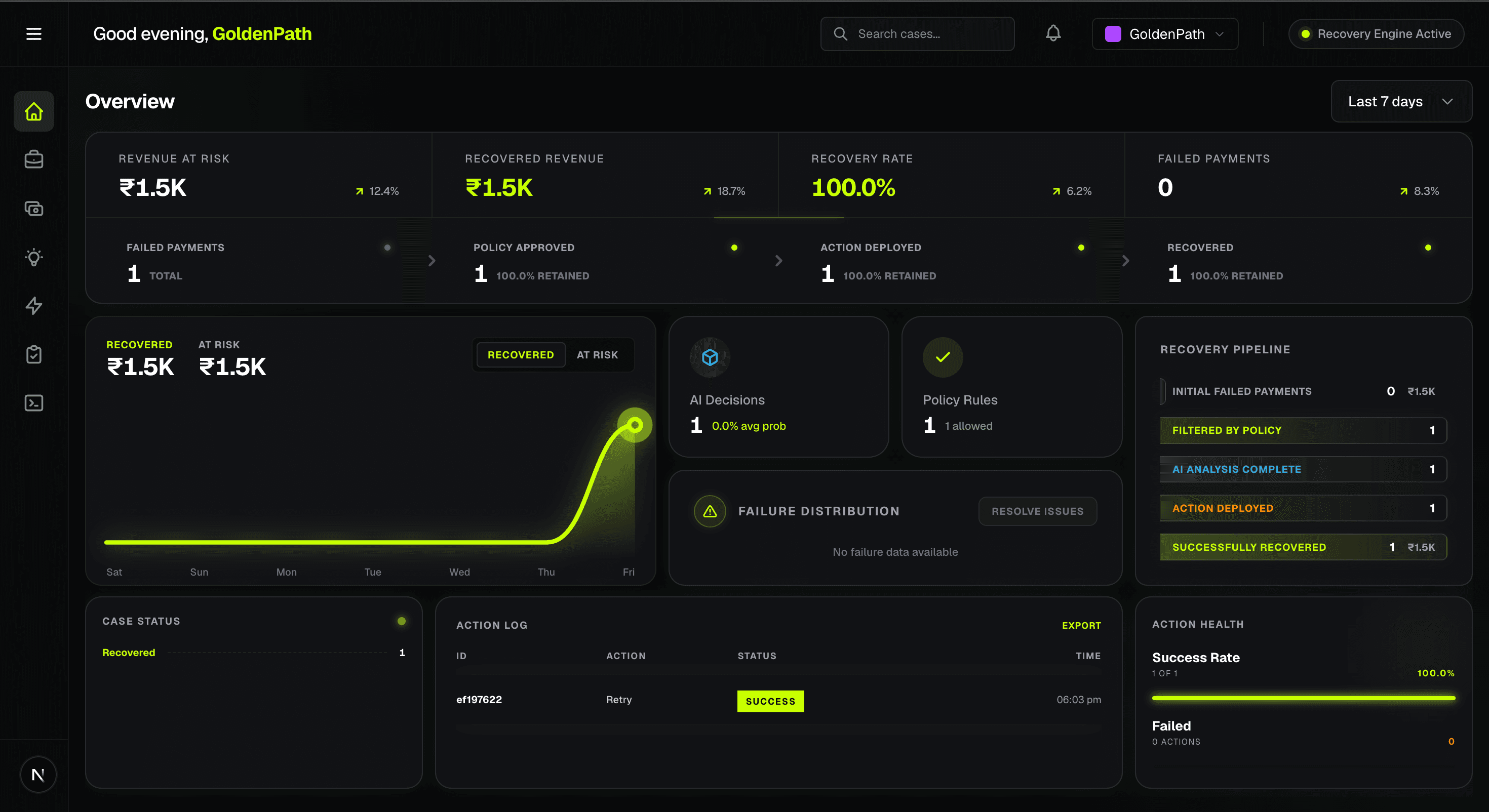
Dashboard UI
Swipe to explore dashboard

The intelligence behind every recovered payment.

Failed payments don’t always mean lost customers. RecoverAI identifies revenue at risk, understands why a payment failed, and determines the safest way to recover it — while keeping every decision measurable and auditable.

See How It Works

AI recommends. Policy decides. Recovery executes. Every rupee is accounted for.

RecoverAI detects the failed payment, identifies the revenue at risk, and creates a recovery case automatically. The payment then enters the recovery pipeline for analysis and action.
The AI agent analyzes the payment context and failure signals to determine the likely cause, estimate recovery probability, and recommend the most suitable recovery action.
No. Every AI recommendation passes through a policy engine first. The policy layer evaluates safety rules, payment history, confidence, retry limits, and approval requirements before any action can run.
The approved recovery action is executed through the appropriate recovery channel. Its progress is tracked from pending to execution, success or failure, with every state transition recorded.
Recovery never becomes a dead end. Failed actions are handled gracefully, the recovery case can be escalated for human attention, and the complete outcome is recorded for analysis.
Every recovery case is linked to its payment and outcome. RecoverAI measures revenue at risk, recovered revenue, recovery rate, failed payments, and recovery performance in real time.
Yes. Every important decision and action is recorded in an audit trail — from revenue risk detection and AI analysis to policy evaluation, execution, recovery, or escalation.
RecoverAI is designed around the Razorpay payment lifecycle, using payment events and webhooks to detect failures and trigger the recovery workflow while keeping payment execution within the merchant's authorized environment.
Events are handled idempotently, so duplicate webhook deliveries don't create duplicate recovery cases or repeat recovery actions.
The merchant's recovery policy remains the final authority. AI recommends; the policy engine decides what is allowed; the execution layer performs only approved actions.